Interesting local SJ band. Here's what it says at CD Baby:
Sweet HayaH is composed of Nehal, Devin, Aaron, and Josh.
Devin and Aaron had been in several bands together prior to the birth of Sweet HayaH. Josh had also played in several bands including "Casey Wickstrom and The After Dinner Theater." Later on, Devin, Aaron, and Josh would form "Suburban Meltdown" - still performing locally.
In the Spring of 2011, Nehal met Devin, Aaron and Josh at an Open Mic. That night, they played a 45 minutes improvised set, and knew they would be playing together for a long time.
Shortly thereafter, the four musicians started collaborating on original material, to eventually form the band now known as Sweet HayaH ("HayaH in Arabic means "Life").
Their music is a fusion of rock, soul, blues, and a touch of world.
Devin posses a knowledge of classical guitar, but enjoys playing and composing tunes in various genres including rock, metal, reggae, etc. Josh and Aaron's versatile playing makes it possible for the band to jam out to Nehal's eclectic tunes. Egyptian-born and French-raised Nehal had been a local solo singer/songwriter who started performing in July 2010. She composes mainly on the piano, and writes songs in English, French, and Spanish.
Sweet HayaH is energy and passion-filled, and ALWAYS looking forward to playing for those who want to listen and groove to their tunes.
(Excerpted from an SFGate review of Jeff Tamarkin's "Got A Revolution" - without permission)
One day in 1965, Marty Balin, an up-and-coming local singer who'd recently co-founded a band called Jefferson Airplane (and who would later become famous for leaping off the stage at Altamont, attacking a Hells Angel who was beating a fan, and being immediately knocked out himself), took acid for the first time. He and roommate Bill Thompson, who would go on to become the Airplane's manager, decided to go for a stroll in the Haight, whereupon, Thompson says in "Got a Revolution!": "A guy comes up and takes a knife out and goes 'Hey, man, give me your money.' Marty looks at me and goes, 'Is this part of the trip?' "
Balin recalls, "I'm looking at this guy and he's sparkling. I'm going, 'Man, you are beautiful.' And then I put my arm around the guy. Finally the guy gave up and said to Thompson, 'Hey, man, you better take this guy to a hospital.' "
The combination of shining innocence, glorious vision and potentially catastrophic cluelessness encapsulated in this moment propagates fractal-like through "Got a Revolution!: The Turbulent Flight of Jefferson Airplane," in which author Jeff Tamarkin traces the band's history from the childhood of its members to the present.
Born from the explosive convergence of youth culture, psychedelics, rock 'n' roll and outrage over the Vietnam War, the Airplane was, for the late '60s and early '70s, at the forefront not only of "The San Francisco Sound" but also of a movement that saw saving the world from government intrusion and societal repression as not merely possible but mandatory. "Now it's time for you and me/ Got a revolution!" Balin would exhort the crowd in his extraordinary voice.
When band members Paul Kantner and Grace Slick were expecting their baby, Kantner's song "A Child Is Coming" suggested not registering births to keep one's children free of authoritarian clutches. (The baby in question, Tamarkin reports, is now a sober Christian living in Southern California.)
The Airplane sold millions of records, influenced hordes of bands and galvanized audiences around the world. Meanwhile, their music was often eclipsed by their offstage antics. They embraced their role as poster children for the transformative properties of sex, drugs and rock 'n' roll, and rarely lost an opportunity to outrage conventional sensibilities -- as Kantner wrote in one lyric: "We are forces of chaos and anarchy/ Everything they say we are, we are/ And we are very/ Proud of ourselves."
(Sadly, the Airplane morphed into the less-interesting Jefferson Starship - who then morphed into the gawdawful Starship with Mickey Thomas and Craig Chaquico, who once unabashedly admitted that Journey and Styx were his favorite bands)
Teach Yourself Fugging: The Lower East Side's First Underground Band Refuses to Burn Out
The thing you have to accept about the Fugs is that they'll never sound as good as you hope. You assume the Lower East Side's first true underground band will be tough, gritty, minimalist, urban protopunks. Uh-uh. That was the Lower East Side's second true underground band, who were never quite as underground despite their name. Lou Reed was a contract songwriter, Andy Warhol a celebrity artist, so the Velvets signed with a major, where The Velvet Underground and Nico climbed all the way to 171 in Billboard. The Fugs recorded first for Folkways's Broadside "subsidiary" and then for ESP-Disk, conceived to promulgate Esperanto, where they became the first rock act ever to crack the Billboard top 100 on an independent label (an arty one, that is). This feat combined brand placement--Norman-Mailer-for-f**k name in the media capital of the world--with lyrics of a sexuality rarely if ever equalled. But ESP-Disk, which made its mark documenting Albert Ayler and other jazz wildmen, doesn't tell you what you need to understand about the Fugs. Folkways does. Like many daring white American rock musicians of the mid '60s, the Fugs were folkies.
All right, so I'm overstating. There were folkies who were musicians--and then surfaced in the Byrds, the Dead, etc.--and folkies who were fans. The Fugs--meaning Ed Sanders and Tuli Kupferberg and not, for now, drummer Ken Weaver--were barely the latter. They were beatnik-turning-hippie poet-politicos who sang "We Shall Overcome" at meetings (Sanders) and had the immemorial folkie habit of pouring new words into old tunes (Kupferberg). That they were hardly musicians at all was definitely kind of punk, and crucial to their sound and achievement. Nevertheless--as was not true of the Velvets, or Bob Seger either--they filled out their band almost exclusively with folkies. Folkies who could play, too, starting with nutcases Peter Stampfel and Steve Weber and ending with technicians who would eventually emigrate to El Lay and back Carole King. Just as important, they had a deep pastoral bent. Lou Reed never set William Blake to music, Frank Zappa either. And you've heard of tree huggers? Here's Sanders's 1966 "Elm Fuck Poem": "How I love to rim/your bark slits/kiss the leaves/above your dripping elm crotch."
The Fugs' Folkways and ESP-Disk sessions remain available (on Fantasy), as does Songs From a Portable Forest (on Gazell), which cherry-picks the politer new material Sanders favored when the band re-formed in 1985, some of which--especially the prolonged, elegiac "Dreams of Sexual Perfection" and "Refuse to Be Burnt Out"--packs considerable power in the poetical mode that usually spells death in rhythm music. But in the '60s the Fugs also signed with a major, two in fact--first Atlantic, which refused to release the resultant album, and then Reprise, where Warners shunted its far-out signings. The Fugs made four albums there, all of which seemed gone forever and will probably be gone again soon. In the meantime, Rhino Handmade, where Rhino shunts its far-out reissues in limited editions of 5000, has brought out Electromagnetic Steamboat: all four Reprise albums plus the previously unavailable Atlantic plus (collectors, you gotta love 'em) the mono version of the Reprise debut Tenderness Junction. Three CDs, $56 shipped, available only at www.rhinohandmade.com--definitely not for everyone, especially since they're unauthorized by the band, which Sanders says hasn't gotten a royalty statement from Warners in 35 years. But just as definitely worth knowing. However obscure the Fugs' corner of rock history may seem, Ed Sanders and Tuli Kupferberg are bigger than that. We're lucky they passed through.
There are poets and there are poets, and don't ask me the difference. But Sanders's Thirsting for Peace in a Raging Century: Poems 1961-1985 won an American Book Award in 1988, and he's published four collections since. A tireless, lifelong radical environmentalist, he also started a biweekly newspaper in Woodstock in 1995. This is no departure--his publishing ventures go back to the pre-Fugs Fuck You: A Magazine of the Arts, his journalistic career to 1971's The Family, an unequivocally disapproving investigation of the Manson murders that will soon be back in print where it belongs. So at 62, he has more going on than any but a few aging rock stars, active icons included.
Now 78, Kupferberg is a less obvious case, because he chose a less achievement-oriented life path. Like his departed contemporaries Neal Cassady and Harry Smith (who brought the band to Folkways), he's a pure bohemian, so well-versed in that proud tradition that he embraces the word itself. His Fugs connection is the highest-status credential of an oeuvre that includes the found-poetry comedy album No Deposit, No Return (out on CD and still funny after 35 years), countless topical lyrics set to one of the thousands of melodies he carries around in his head, two volumes of celebrity baby photos, and, most recently, Teach Yourself Fucking, a collection of crude cartoons and collages, mostly political, featuring, every 15 pages or so, "The Old Fucks at Home," in which two geezers one assumes to be Tuli and his mate (known around here as forceful former Voice production manager Sylvia Topp) watch TV and kibitz. "Flirt globally," "Fuck locally," goes one exchange. Another: "I'm going to be discovered after I die," "I hope it ain't too long after . . . you'll stink like hell."
The conventional wisdom is that the Fugs cleaned up too much on Reprise. This is debatable. Certainly the problem isn't the accomplished playing--it's material written after their first burst, when they were ejaculating poetic smut faster than hydropathes at a circle jerk. Few of the later songs have the scabrous rightness of "Kill for Peace" or "Doin' All Right" (with the famous line about screwing your mom), neither ever re-recorded. But most of the ace material on the Folkways debut was substantially improved on the farewell live Golden Filth. And while the ESP LP (now called The Fugs Second Album) is somewhat more consistent than the Reprise debut Tenderness Junction, it includes items no one mentions anymore ("Frenzy," "Skin Flowers") as well as the 11-minute fantasia "Virgin Forest," which isn't redeemed by its sex parts. I prefer Tenderness Junction's "Aphrodite Mass (In Five Sections)," easily the most dubious of the many tracks--pullulating "The Garden Is Open," brutal "War Song," doomed "Dover Beach"--on which musicianship comes to the aid of the part of Sanders that wasn't content describing group gropes. It's his NYU classics major side, his prizewinning side; not even Patti Smith made such convincing rock and roll from the likes of Blake, Arnold, Olson, and Berrigan. But for 20 tracks in 33 minutes, Sanders's poetic nature runs amok on It Crawled Into My Hand, Honest, one of the most eccentric albums ever financed by a major corporation. Right, I love the way "River of Shit" ("Wide Wide River" in the booklet) is surrounded by "Burial Waltz" and "Life Is Strange," both slightly superior versions of exactly what you'd fear. But the laughs are too rare.
Which brings us to long-departed avatar Weaver, the drummer-songwriter-monologist of whose current whereabouts Kupferberg has said: "Ken Weaver was born again and hasn't learned to talk yet." Truth is, as a reputed CIA translator with his name on a well-loved compendium of Texas vernacular ("slick as two eels fuckin' in a bucket of snot") as well as "Wide Wide River," "Slum Goddess," and "I Couldn't Get High," Weaver, like Kupferberg, probably remains a very funny man. Back when New Yorkers could catch the Fugs free at a different demo every month, he was an anything-for-a-laugh guy with no discernible poetic side--the one you could imagine actually trying to put his bad thing in a lesbian dwarf. But the rhetoric was Sanders's. For of course, beyond poetry and revolution, the Fugs were always (a) brazenly sexual and (b) unapologetically hilarious. Only Frank Zappa did anything comparable--and for Zappa, a very anal fellow, sex was interesting to the precise extent that it was also demeaning. The Fugs loved the stuff, enough to embarrass Richie Unterberger in his generally excellent notes to the Rhino set: "the humor can seem juvenile several decades down the road, when such language in popular culture isn't as shocking as it once was." But the Fugs never relied on so-called four-letter words. Instead, as becomes fully apparent on the monologues of the live Golden Filth, they were rich in incident and circumlocuted like crazy--like poets. "She's lying down in viscid, skooshy strands of cherry Jell-O, buttocks popping in arpeggios of lust. . . . She is as horny as a heathen. Her dildo is made out of a petrified tapir snout. Around her neck is an amulet made from onyx-colored tit wax."
Actually, Sanders does apologize for the '60s Fugs' testosterone content, but to me their comedy drips--nay, pullulates--with agape, tenderness, and sensual awareness. If it's long on high school jokes, well, most of the audience was under 25. And whatever the biographical details, about which I always used to wonder when our paths crossed back then, I note that Ed and Tuli have each stayed with one strong woman since the band began. I note also that their political passions remain uncompromised. Sanders, who wrote his first major poem on prison toilet paper after attempting to board a nuclear submarine in 1961, still commits acts of civil disobedience, and Teach Yourself Fucking is full of attacks on the war machine and The New York Times. They're recording a "final" album, too. Maybe their depth of commitment, as well as their genius, is why their '60s music, for all of its evident missteps and shortcomings, sounds even more compelling now than it did when they were a cultural force. I wish I could say as much of technically accomplished contemporaries like the Byrds and the Band. But I can't. I just checked.
Pity the poor Yardbirds. Doomed forever to be remembered only in the shadow of their three former lead guitaritst; Clapton, Beck, and Page.
Yet The Yardbirds were far more than just a proving ground for their guitar heroes. In their music are the first rumblings of territory that would later be explored by Cream, Led Zep, and Beck's solo albums. More importantly, those rumblings took place in a context that, for my money, is often a lot more rewarding.
And The Yardbirds were always, a band. And a very great one. You can hear their echoes not only in the extemporizations of Cream and the exoticisms and bluesy pounding of Led Zep (for which they are often credited), but also the energy-freeform-freakout of the MC5, Stooges, Television, Feelies, and Voidoids. And their tough stance and driving music were an enormous influence on American garage bands, nearly as important as their fellow Londoners the Stones and The Who.
Their early records were mostly blues covers. And mostly average. They had a lot of energy, but simply never had the expertise and feel of the Stones, Them, or The Animals, all of whom surpassed them by light years in this department. Also, though already a sterling guitarist, Clapton was not yet producing at the level he soon would be in John Mayall's Bluesbreakers. A few of their r&b covers had some kick (Billy Boy Arnold's "I Wish You Would"), but most are merely adequate.
Then came Graham Gouldman's "For Your Love," a change in direction from straight blues to "pop" ... or more accurately, straight-up rock and roll. Exit Clapton, and enter Beck. And now the fun begins. In a series of singles and EP's (later collected into LPs in the UK and America) from early 1965 to the end of 1966 - an alarmingly short time to produce such a body of work - they inflicted on the world a set of hard-hitting, edgy, strikingly innovative rock`n'roll, driven not only by the overpowering guitars (Beck played lead on all of these), but also a powerhouse rhythm section, a sinister, snaky lead singer, and a dazzling sense of dynamics, mostly courtesy of bassist Paul Samwell-Smith.
Too good to last. By the end of `66 Samwell-Smith was gone, and Beck would follow him soon after, leaving Page in charge. In and of itself this was no bad thing, but their last sessions with Mickie Most, while not without interest, were schizophrenic, alternating between bizarre flower-powerish numbers like "Ha Ha Said The Clown" and more typical Yardbirds fare such as "Drinking Muddy Water."
The Yardbirds petered out after a 1968 tour, with Relf and McCarty forming the folkie/medieval Renaissance, while Page and Dreja pursued what would become Led Zeppelin. Relf passed away in 1976 after a bizarre electrical accident. Dreja and McCarty reformed The Yardbirds in the 80's and 90's and continue to tour.
A giant of a man, probably the greatest blues singer who ever lived, and certainly the single blues singer most influential on rock and roll. There was never anything like him before, or after. You can hear echoes of him on down through the British blues/rock bands, Tom Waits, The Gun Club, The Stooges, even now in the White Stripes. Blues singer is far too small a label for such mountain of talent.
He started his career late, terrorizing the clubs around Memphis and recording for Sam Phillips (most of those sides ended up getting leased to Chess). Most of those early sides are upbeat, good time jump blues, but Wolf's personality was already in full force; overpowering, overwhelming; the man was a force of nature.
In the mid-fifties, Wolf migrated from Memphis to Chicago (the enjoyable film Cadillac Records gets it wrong. Wolf, who was financially successful and financially smart, drove up in a suit, and Cadillac) and began recording in the Chess studios, usually with Hubert Sumlin on board on lead guitar. Sumlin became a critical part of Wolf's tougher, darker, doomier sound. In 1959 and 1962, Chess released two stone classic Wolf albums, Moanin' in the Moonlight (1959) and Howlin' Wolf (1962). They are essential.
As the sixties wore on, Wolf became an icon among blues-crazed London listeners, and a well-known if not truly famous at home. He slowed down, and his music did too (though the occasional fast one would appear, such as the Stooges-like "Do The Do" (1962). But the talent was always there and, even after he peaked, his lesser creations were still well worth hearing. His health failed him, but he never stopped, performing until he was no longer able. He recorded an album in London with Clapton, Charlie Watts, et al that is beloved of those too wimpy to deal with his real sides, and derided by those too prudish to admit that it has its merits (it's not a bad album, but it's a long way from great). In 1973 he recorded one last album, The Back Door Wolf, for Chess. Despite having a few weak spots, it's excellent, and contained at least one last classic, "Coon On The Moon," a hymn to black pride.
Let's be straight here - Chilton's a legend, he's influential as hell, and his solo albums are erratic at best (I realize they all have their adherents). For my money, you can easily get all the solo Chilton songs I'd ever need to hear twice on a single disk and still have plenty of room.
The truth is the guy spent his post-Big Star years pumping out (first) a set of falling-apart-at-the-seams, paint spatters everywhere sessions that eventually got released as albums that were at best pleasant but mostly forgettable, after you got after the initial shock of hearing such ramshackle performances. Yeah, I know - Like Flies On Sherbert is supposed to be a classic and all. I only wish I shared that opinion.
After drying out in New Orleans, he set to work knocking out more professional, enjoyable, but still less-than-brilliant albums that mixed vintage R&B covers (often obscure ones), Italian pop songs from the 50's, and originals that were usually vintage R&B-style workouts and were generally jokes (often dirty). Some of it was inspired, none of it was awful ... but none of it was timeless. Other than that he toured his ass off, sometimes with a reunited Big Star, sometimes on the oldies circuit with The Box Tops, sometimes on his own.
Many argued that this was all part of some grand artistic statement: that the sloppy early albums were a deliberate deconstruction; that the later albums and tours were a deliberate defiance of fan demands and expectations.
Myself, I suspect Chilton toured and recorded because the bills had to be paid and that was what he knew how to do. It certainly beat washing dishes (which he was allegedly reduced to for a time). I don't fault him for that. I do fault him for the whiff of contempt I often detected in his efforts. And most of all I fault the hip young rock crits who hailed his every move as a work of genius when they wouldn't have been caught dead listening to the original versions of those R&B songs Chilton made most of his later repertoire from.
I saw him in San Jose in 1988. He did a bunch of oldies (a cool version of The Coasters' "Young Blood"), some stuff off then-current album High Priest, a couple of Big Star numbers. His guitar playing was stunning. It was essentially a good bar-band show. I'm pretty sure the college kids, mostly Big Star fans who'd been led there by rock critics and The Replacements tribute song (like me), were a bit baffled by the whole thing. I was too. But I admit, despite is ramshackle and slightly "I-don-t-give-a-shit" nature, Chilton could never totally hide his talent. And that's what people saw in him, I suspect. The shame is that he felt he needed to in the first place.
Essential Listening:
Like Flies On Sherbert (not a great album, but the only way to get "Hey Little Child," my favorite Chilton song) 19 Years (pretty well covers the rest)
I'll be honest, I'm not as hot and bothered about Big Star as many cultists. I think their best music lives up to all the claims made for it, but their albums are spotty. Nevertheless, they are a remarkable artifact, and deserve their legend. Here's a pretty astute piece from Pitchfork on Big Star, written by Joe Tangari and stolen without permission:
Alex Chilton, who died last week at the age of 59, had a strange and complicated relationship with fame. He achieved it early as the lead singer for the Box Tops, struggled to recapture it in the 1970s with Big Star, and spent a decade pushing it away after that band broke up. As easy as it is to imagine an alternate reality in which Paul Westerberg's line above is more than just a fantasy, that's not what happened.
Chilton was just 16 when "The Letter" topped the U.S. singles chart in 1967. The song isn't even two minutes long, but it set the course for the rest of his life. After its success, his parents let him quit high school, where he was already failing, to be in the Box Tops full time and try to succeed as a musician. The band scored several further hits and became one of the defining blue-eyed soul groups, due in no small part to Chilton's gritty-beyond-his years vocals.
In spite of their success, Chilton grew unhappy with the Box Tops and precipitated the band's breakup by storming offstage in mid-performance in late 1969. After turning down an offer to become the lead singer for Blood, Sweat & Tears-- he thought the band was too commercial-- Chilton worked to become a better guitarist and began an abortive attempt to record a solo album (the results can be heard on Ardent's 1996 compilation 1970). Ultimately, he found himself back home in Memphis, where he joined Big Star in 1971.
In Big Star, Chilton dropped the soul-man vocal style he'd made his name on in favor of a reedier, more natural delivery. He found a natural partner in the band's other main songwriter, Chris Bell, and the quartet cultivated a sound indebted more to the guitar-driven Byrds and the British Invasion bands than to their hometown's soul heritage. Their first album, optimistically (or sarcastically, depending on who you ask) titled #1 Record, is a deathless power-pop masterpiece that garnered considerable acclaim on its release in 1972 and deserved every bit of it.
Listening to the album today, it's striking how much variety and tension the band packed into it. "Thirteen" is haunted and desperate, "When My Baby's Beside Me" is celebratory and propulsive, "Don't Lie To Me" explodes with macho energy, while the gentle, acoustic "Watch the Sunrise" matches its intensity in spite of its beauty. "In the Street" is the only Big Star song a lot of people know on account of its use (in a cover version by Cheap Trick) as the theme song for "That 70s Show", and you can see why the show's producers chose it: Is there a couplet that embodies suburban teenage boredom more completely than "Wish we had/ A joint so bad"?
#1 Record could have launched Big Star into orbit, but the record industry got in the way. Stax Records was in decline and unable to adequately distribute the album-- when kids who'd read the rave review in Rolling Stone went out to buy it, it was nowhere to be found. It only got worse when Stax signed its distribution over to Columbia, which had no interest in Big Star and pulled the few copies of the album that had made it to shelves. The album's failure nearly destroyed Big Star. Bell, who'd already seen Chilton eclipse him in his own band, quit the group, then rejoined. They broke up after a few months of tumult, and finally reconvened without Bell.
Radio City, the resulting album, is nearly as good as its predecessor, and bristles with a charged, live feel. On its own, #1 Record probably would have been enough to build a legend for the band, but the two albums together, as they've often been sold in subsequent reissues, are extraordinarily powerful and influential. They work as a pair to paint an amazing picture of American youth and all its contradictions, frustrations, desires, and disappointments.
Radio City's fate is a near mirror-image of #1 Record's. Columbia barely distributed it, and all the great reviews in the world weren't enough to make a hit out of a record no one could obtain. Bassist Andy Hummel left to focus on school, leaving Chilton and drummer Jody Stephens to carry on as a pair, working with producer Jim Dickinson on the third Big Star LP.
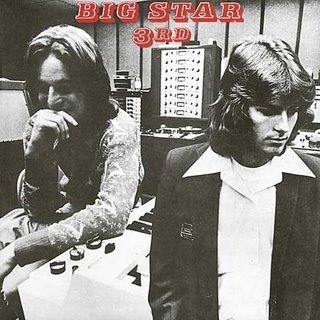
Sister Lovers, which Columbia refused to even release at the time, is a fractured, defiant document of a band that seemed to have stopped caring whether their music topped the charts or played on the radio. Chilton had always tried to do things his way, but here, he took that to an extreme, creating a record stretched bizarrely between the poles of refined orchestral pop and crumbling, willfully difficult soundtracks for clinical depression.
The string arrangements on the album are never anything short of stately, which makes them sound all the more odd sawing their way out of tangled songs like "Stroke It, Noel" and "Nightime", the latter of which is the most ghostly song in Chilton's varied discography. When the album was rejected, Big Star called it quits, and Chilton headed out on his own in late 1975, restarting the solo career he'd put on hold for Big Star.
From the sound of his first eight years of solo work, Chilton had no interest in trying to play ball with record labels and radio programmers. He produced early records by the Cramps and left Memphis for New York. His solo work in the late 70s and early 80s was confrontational and often had more in common with the Red Krayola than the Beatles and the Kinks. His 1979 solo album, Like Flies on Sherbert, is one of the most ramshackle, messy LPs I've ever heard, and that's obviously the intent. It's as though, finding himself thwarted when he tried to achieve success and fame on his own terms, Chilton reversed course and tried as hard as possible to push the spotlight away from himself.
And it would have worked, too, if it hadn't been for the fact that the Big Star albums were too good to stay hidden forever. Young musicians discovered them and sang their praises. Suffice to say American college radio would have sounded awfully different in the 80s if not for Big Star. It's hard to even imagine R.E.M. without them, and of course the Replacements made their debt to Chilton clear on Pleased to Meet Me. Chilton himself didn't quite get all the fuss over the Big Star albums. In a 2007 interview with Russell Hall of Gibson Guitars, he put it this way: "I'm not as crazy about them as a lot of Big Star cultists seem to be. I think they're good, but then again, I think Slade records are good, too."
Chilton's solo work in the mid 80s backed away from the intentional disarray of his early material, gravitating toward R&B and blues, and he was quietly prolific during the 90s. He and Stephens got back together with the Posies' Jon Auer and Ken Stringfellow standing in for Hummel and Bell in 1993, and over the past decade, that quartet continued to tour and even recorded an album together. Chilton had something of a dual reunion life, playing to hip indie rock kids in Big Star while also doing the occasional oldies circuit gig with a reunited Box Tops.
In his later years, Chilton settled in New Orleans. He'd been planning to play at SXSW this past weekend, and seemed comfortable with his elder-statesman status. He managed to finally achieve some of the success on his own terms that had so long eluded him-- the world sometimes takes a while to catch up to a great artist.