Pity the poor Yardbirds. Doomed forever to be remembered only in the shadow of their three former lead guitaritst; Clapton, Beck, and Page.
Yet The Yardbirds were far more than just a proving ground for their guitar heroes. In their music are the first rumblings of territory that would later be explored by Cream, Led Zep, and Beck's solo albums. More importantly, those rumblings took place in a context that, for my money, is often a lot more rewarding.
And The Yardbirds were always, a band. And a very great one. You can hear their echoes not only in the extemporizations of Cream and the exoticisms and bluesy pounding of Led Zep (for which they are often credited), but also the energy-freeform-freakout of the MC5, Stooges, Television, Feelies, and Voidoids. And their tough stance and driving music were an enormous influence on American garage bands, nearly as important as their fellow Londoners the Stones and The Who.
Their early records were mostly blues covers. And mostly average. They had a lot of energy, but simply never had the expertise and feel of the Stones, Them, or The Animals, all of whom surpassed them by light years in this department. Also, though already a sterling guitarist, Clapton was not yet producing at the level he soon would be in John Mayall's Bluesbreakers. A few of their r&b covers had some kick (Billy Boy Arnold's "I Wish You Would"), but most are merely adequate.
Then came Graham Gouldman's "For Your Love," a change in direction from straight blues to "pop" ... or more accurately, straight-up rock and roll. Exit Clapton, and enter Beck. And now the fun begins. In a series of singles and EP's (later collected into LPs in the UK and America) from early 1965 to the end of 1966 - an alarmingly short time to produce such a body of work - they inflicted on the world a set of hard-hitting, edgy, strikingly innovative rock`n'roll, driven not only by the overpowering guitars (Beck played lead on all of these), but also a powerhouse rhythm section, a sinister, snaky lead singer, and a dazzling sense of dynamics, mostly courtesy of bassist Paul Samwell-Smith.
Too good to last. By the end of `66 Samwell-Smith was gone, and Beck would follow him soon after, leaving Page in charge. In and of itself this was no bad thing, but their last sessions with Mickie Most, while not without interest, were schizophrenic, alternating between bizarre flower-powerish numbers like "Ha Ha Said The Clown" and more typical Yardbirds fare such as "Drinking Muddy Water."
The Yardbirds petered out after a 1968 tour, with Relf and McCarty forming the folkie/medieval Renaissance, while Page and Dreja pursued what would become Led Zeppelin. Relf passed away in 1976 after a bizarre electrical accident. Dreja and McCarty reformed The Yardbirds in the 80's and 90's and continue to tour.
A giant of a man, probably the greatest blues singer who ever lived, and certainly the single blues singer most influential on rock and roll. There was never anything like him before, or after. You can hear echoes of him on down through the British blues/rock bands, Tom Waits, The Gun Club, The Stooges, even now in the White Stripes. Blues singer is far too small a label for such mountain of talent.
He started his career late, terrorizing the clubs around Memphis and recording for Sam Phillips (most of those sides ended up getting leased to Chess). Most of those early sides are upbeat, good time jump blues, but Wolf's personality was already in full force; overpowering, overwhelming; the man was a force of nature.
In the mid-fifties, Wolf migrated from Memphis to Chicago (the enjoyable film Cadillac Records gets it wrong. Wolf, who was financially successful and financially smart, drove up in a suit, and Cadillac) and began recording in the Chess studios, usually with Hubert Sumlin on board on lead guitar. Sumlin became a critical part of Wolf's tougher, darker, doomier sound. In 1959 and 1962, Chess released two stone classic Wolf albums, Moanin' in the Moonlight (1959) and Howlin' Wolf (1962). They are essential.
As the sixties wore on, Wolf became an icon among blues-crazed London listeners, and a well-known if not truly famous at home. He slowed down, and his music did too (though the occasional fast one would appear, such as the Stooges-like "Do The Do" (1962). But the talent was always there and, even after he peaked, his lesser creations were still well worth hearing. His health failed him, but he never stopped, performing until he was no longer able. He recorded an album in London with Clapton, Charlie Watts, et al that is beloved of those too wimpy to deal with his real sides, and derided by those too prudish to admit that it has its merits (it's not a bad album, but it's a long way from great). In 1973 he recorded one last album, The Back Door Wolf, for Chess. Despite having a few weak spots, it's excellent, and contained at least one last classic, "Coon On The Moon," a hymn to black pride.
Let's be straight here - Chilton's a legend, he's influential as hell, and his solo albums are erratic at best (I realize they all have their adherents). For my money, you can easily get all the solo Chilton songs I'd ever need to hear twice on a single disk and still have plenty of room.
The truth is the guy spent his post-Big Star years pumping out (first) a set of falling-apart-at-the-seams, paint spatters everywhere sessions that eventually got released as albums that were at best pleasant but mostly forgettable, after you got after the initial shock of hearing such ramshackle performances. Yeah, I know - Like Flies On Sherbert is supposed to be a classic and all. I only wish I shared that opinion.
After drying out in New Orleans, he set to work knocking out more professional, enjoyable, but still less-than-brilliant albums that mixed vintage R&B covers (often obscure ones), Italian pop songs from the 50's, and originals that were usually vintage R&B-style workouts and were generally jokes (often dirty). Some of it was inspired, none of it was awful ... but none of it was timeless. Other than that he toured his ass off, sometimes with a reunited Big Star, sometimes on the oldies circuit with The Box Tops, sometimes on his own.
Many argued that this was all part of some grand artistic statement: that the sloppy early albums were a deliberate deconstruction; that the later albums and tours were a deliberate defiance of fan demands and expectations.
Myself, I suspect Chilton toured and recorded because the bills had to be paid and that was what he knew how to do. It certainly beat washing dishes (which he was allegedly reduced to for a time). I don't fault him for that. I do fault him for the whiff of contempt I often detected in his efforts. And most of all I fault the hip young rock crits who hailed his every move as a work of genius when they wouldn't have been caught dead listening to the original versions of those R&B songs Chilton made most of his later repertoire from.
I saw him in San Jose in 1988. He did a bunch of oldies (a cool version of The Coasters' "Young Blood"), some stuff off then-current album High Priest, a couple of Big Star numbers. His guitar playing was stunning. It was essentially a good bar-band show. I'm pretty sure the college kids, mostly Big Star fans who'd been led there by rock critics and The Replacements tribute song (like me), were a bit baffled by the whole thing. I was too. But I admit, despite is ramshackle and slightly "I-don-t-give-a-shit" nature, Chilton could never totally hide his talent. And that's what people saw in him, I suspect. The shame is that he felt he needed to in the first place.
Essential Listening:
Like Flies On Sherbert (not a great album, but the only way to get "Hey Little Child," my favorite Chilton song) 19 Years (pretty well covers the rest)
I'll be honest, I'm not as hot and bothered about Big Star as many cultists. I think their best music lives up to all the claims made for it, but their albums are spotty. Nevertheless, they are a remarkable artifact, and deserve their legend. Here's a pretty astute piece from Pitchfork on Big Star, written by Joe Tangari and stolen without permission:
Alex Chilton, who died last week at the age of 59, had a strange and complicated relationship with fame. He achieved it early as the lead singer for the Box Tops, struggled to recapture it in the 1970s with Big Star, and spent a decade pushing it away after that band broke up. As easy as it is to imagine an alternate reality in which Paul Westerberg's line above is more than just a fantasy, that's not what happened.
Chilton was just 16 when "The Letter" topped the U.S. singles chart in 1967. The song isn't even two minutes long, but it set the course for the rest of his life. After its success, his parents let him quit high school, where he was already failing, to be in the Box Tops full time and try to succeed as a musician. The band scored several further hits and became one of the defining blue-eyed soul groups, due in no small part to Chilton's gritty-beyond-his years vocals.
In spite of their success, Chilton grew unhappy with the Box Tops and precipitated the band's breakup by storming offstage in mid-performance in late 1969. After turning down an offer to become the lead singer for Blood, Sweat & Tears-- he thought the band was too commercial-- Chilton worked to become a better guitarist and began an abortive attempt to record a solo album (the results can be heard on Ardent's 1996 compilation 1970). Ultimately, he found himself back home in Memphis, where he joined Big Star in 1971.
In Big Star, Chilton dropped the soul-man vocal style he'd made his name on in favor of a reedier, more natural delivery. He found a natural partner in the band's other main songwriter, Chris Bell, and the quartet cultivated a sound indebted more to the guitar-driven Byrds and the British Invasion bands than to their hometown's soul heritage. Their first album, optimistically (or sarcastically, depending on who you ask) titled #1 Record, is a deathless power-pop masterpiece that garnered considerable acclaim on its release in 1972 and deserved every bit of it.
Listening to the album today, it's striking how much variety and tension the band packed into it. "Thirteen" is haunted and desperate, "When My Baby's Beside Me" is celebratory and propulsive, "Don't Lie To Me" explodes with macho energy, while the gentle, acoustic "Watch the Sunrise" matches its intensity in spite of its beauty. "In the Street" is the only Big Star song a lot of people know on account of its use (in a cover version by Cheap Trick) as the theme song for "That 70s Show", and you can see why the show's producers chose it: Is there a couplet that embodies suburban teenage boredom more completely than "Wish we had/ A joint so bad"?
#1 Record could have launched Big Star into orbit, but the record industry got in the way. Stax Records was in decline and unable to adequately distribute the album-- when kids who'd read the rave review in Rolling Stone went out to buy it, it was nowhere to be found. It only got worse when Stax signed its distribution over to Columbia, which had no interest in Big Star and pulled the few copies of the album that had made it to shelves. The album's failure nearly destroyed Big Star. Bell, who'd already seen Chilton eclipse him in his own band, quit the group, then rejoined. They broke up after a few months of tumult, and finally reconvened without Bell.
Radio City, the resulting album, is nearly as good as its predecessor, and bristles with a charged, live feel. On its own, #1 Record probably would have been enough to build a legend for the band, but the two albums together, as they've often been sold in subsequent reissues, are extraordinarily powerful and influential. They work as a pair to paint an amazing picture of American youth and all its contradictions, frustrations, desires, and disappointments.
Radio City's fate is a near mirror-image of #1 Record's. Columbia barely distributed it, and all the great reviews in the world weren't enough to make a hit out of a record no one could obtain. Bassist Andy Hummel left to focus on school, leaving Chilton and drummer Jody Stephens to carry on as a pair, working with producer Jim Dickinson on the third Big Star LP.
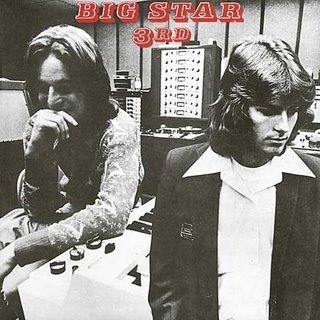
Sister Lovers, which Columbia refused to even release at the time, is a fractured, defiant document of a band that seemed to have stopped caring whether their music topped the charts or played on the radio. Chilton had always tried to do things his way, but here, he took that to an extreme, creating a record stretched bizarrely between the poles of refined orchestral pop and crumbling, willfully difficult soundtracks for clinical depression.
The string arrangements on the album are never anything short of stately, which makes them sound all the more odd sawing their way out of tangled songs like "Stroke It, Noel" and "Nightime", the latter of which is the most ghostly song in Chilton's varied discography. When the album was rejected, Big Star called it quits, and Chilton headed out on his own in late 1975, restarting the solo career he'd put on hold for Big Star.
From the sound of his first eight years of solo work, Chilton had no interest in trying to play ball with record labels and radio programmers. He produced early records by the Cramps and left Memphis for New York. His solo work in the late 70s and early 80s was confrontational and often had more in common with the Red Krayola than the Beatles and the Kinks. His 1979 solo album, Like Flies on Sherbert, is one of the most ramshackle, messy LPs I've ever heard, and that's obviously the intent. It's as though, finding himself thwarted when he tried to achieve success and fame on his own terms, Chilton reversed course and tried as hard as possible to push the spotlight away from himself.
And it would have worked, too, if it hadn't been for the fact that the Big Star albums were too good to stay hidden forever. Young musicians discovered them and sang their praises. Suffice to say American college radio would have sounded awfully different in the 80s if not for Big Star. It's hard to even imagine R.E.M. without them, and of course the Replacements made their debt to Chilton clear on Pleased to Meet Me. Chilton himself didn't quite get all the fuss over the Big Star albums. In a 2007 interview with Russell Hall of Gibson Guitars, he put it this way: "I'm not as crazy about them as a lot of Big Star cultists seem to be. I think they're good, but then again, I think Slade records are good, too."
Chilton's solo work in the mid 80s backed away from the intentional disarray of his early material, gravitating toward R&B and blues, and he was quietly prolific during the 90s. He and Stephens got back together with the Posies' Jon Auer and Ken Stringfellow standing in for Hummel and Bell in 1993, and over the past decade, that quartet continued to tour and even recorded an album together. Chilton had something of a dual reunion life, playing to hip indie rock kids in Big Star while also doing the occasional oldies circuit gig with a reunited Box Tops.
In his later years, Chilton settled in New Orleans. He'd been planning to play at SXSW this past weekend, and seemed comfortable with his elder-statesman status. He managed to finally achieve some of the success on his own terms that had so long eluded him-- the world sometimes takes a while to catch up to a great artist.
It took me a long time to really get the MC5. I mean, I snapped up Kick Out the Jams when I came across it at Recycled Records because it was, y'know, a fabled "proto-punk" classic of the Velvets, Stooges sort (and I knew I liked them)(the copy I found had a large round sticker with a cartoon of a safety pin that read "PUNK"). But when I got it home I found it kind of a surprise, kind of a letdown; a really noisy live album that sounded closer to early heavy metal than "punk," the political content which Dave Marsh et al always made so much about (comparing them to The Clash) sounded minimal, and the damn thing was so clattering and noisy and almost sloppy-sounding that it was hard to even pick out the good stuff. I was puzzled, because so far I had loved all these critically-acclaimed punk progenitors, but Kick Out the Jams didn't quite do it for me.
I think maybe a year later I came across Back in the USA. And I had problems with that one, too. It was sooooo tight that the band sound constipated, and there was no bottom, the sound so thin it was like listening to a transistor radio (I'm not a fan of "arty" production - I want rock records to ROCK). Some of the songs were really good, though. A couple years after that I also picked up the Babes in Arms collection. Again, some cool stuff there but again, I still wanted my socks knocked off and it wasn't happening. In the end, I liked the MC5 okay, but I didn't love them. And since I loved the Stooges, Dolls, Velvets, I wanted to love the MC5.
Various things happened over the years. Dave Marsh's "The MC5: Back On Shakin' Street" helped me believe that there was still something in the MC5 that I needed to connect with, and introduced me to "Black To Comm" - even if all he did was describe it. Clinton Heylin's From the Velvets to the Voidoids helped me understand the 5's free-jazz aspirations, and made them more interesting. I picked up a few bootlegs along the way - all disappointing, all had their moments.
Then Wayne Kramer's great solo album The Hard Stuff came out. I loved his version of "Poison" ("his" version is an odd way to put it, since he wrote the song in the first place). Honestly, I felt The Hard Stuff was a realization of what the 5 had been striving for. But it helped me to understand that concept - that they had been striving for something - and achieving it, too, at least part of the time. I became a big Kramer fan and followed his career in the 90's.
Another big step to understanding was the MC5 retrospective in Addicted to Noise in the late 90's. ATN may have been full of shit much of the time, but this issue was superb. And the centerpiece was a long, long interview with Kramer where he spoke of the Detroit music scene, the MC5, the politics of the 60's, at length, with great honesty and insight. He freely admitted the band's many mistakes, but also articulated, again, what they had tried to do.
Great kudos also go to Perfect Sound Forever's MC5 tribute, which helped me understand even further, and helped me really perceive the 5's influences and the context of the band and their music. (I contributed a piece on Wayne's solo albums.)
Oh, and I finally, finally got High Time, which I think is the one 5 album where they finally cooked it up right and made a consistent, and good-sounding, album. Can't believe I neglected that one all those years.
So nowadays, I do love the MC5. But I love them more for their story than for their records. This is not to say they didn't make some good records (none of them are bad). I think what it points to is that the 5 (and Kramer, Thompson and Davis freely admit to this in interviews in Brett Callwood's rough but loving MC5: Sonically Speaking), that the MC5 were basically a live band. They perfected a live show that was, by all accounts, overpowering - the equal of anything any of their brethren (such as role models The Who) were dishing out (perhaps even the superior of many). But, unlike The Who, who had the benefit of entering the studio with a rock-solid producer and engineer from day one (Shel Talmy and Glyn Johns), allowing them to learn how to put themselves across effectively on vinyl. Yes, Kit Lambert fucked up the records that followed until the band finally put their foot down, but they learned enough that even Lambert couldn't ruin them the way Landau did the 5.
The problem this created for them is that a great live show can't be recorded, really. In other words, Kick Out the Jams probably was a total mindfuck if you were standing in front of the stage that night in late 1968, but the resultant album almost couldn't help but turn out something of a muddy mess (which it is - but admittedly a glorious one) once pressed into black grooves. Maybe a sharp engineer like, again, Glyn Johns, could have polished it into the equal of Live At Leeds (I have heard numerous live Who recordings from the same era as KOTJ, and many of those are muddy and messy as well. But The Who had better sound people, better equipment, and were a more disciplined group as well - another thing I suspect the 5 would freely admit).
In the case of album # 2, they fucked themselves by making what was probably the worst choice of producer they possibly could. Now look, I happen to like Springsteen (he's overrated - that doesn't mean he isn't good) and Landau did a good job with him - ten years later. If he'd given Back in the USA the kind of sound he gave Bruce on Darkness and The River, Back would at least sounded decent, not like the tinny shriek that it came out.
But it still wouldn't have served them. Landau saw only one side of the band as valid (ass-kicking, basic rock and roll) and had no use for the other side (sprawling, free jazz-influenced science-fiction rock). In so doing he did the band a great disservice, because the MC5 were about both those sides, and each side informed the other. By stripping away the part of the band that made "Starship" and "Black To Comm," he also stripped away the part that made "Kick Out the Jams" and "Ramblin' Rose" so exciting. All they had learned from James Brown and Sun Ra was left behind. The surviving band members, I should note, all have good things to say about Landau as a person and seem to agree that he did his best and did what he thought was right. Nonetheless, he was a disastrous choice for them. They should've taken a tip from the Stooges and gotten Don Gallucci.
What makes album #3 their best is that it manages to restore what Landau took away (energy free-form-freakout) while managing to also retain the handful of good things Landau brought to them (discipline, being in tune and in time). The songs are among their smartest and sharpest and they still manage to capture their passion and imagination. Its just a damn shame the band had to fall apart almost immediately after, since the surviving relics of the post-5 activities of the band members indicate they all still had it, and, had they not succumbed to drugs and despair, they no doubt would have gotten the hit records they so yearned for.
But they did. And so the story ended. It saddens me that I never even got to see a good reunion tour, thanks to the too-early demise of Tyner and Smith, and, since I missed DKT/MC5, I didn't even get to see a good tribute tour, though I hope that Kramer and Thompson will still do something in the future.
So, my hats off to the 5. It took a while, but now, I do get them. And I do love them. And I love that Kramer and Thompson (and John Sinclair, too) are all still out there, fighting the good fight as best they can. Praise the lord and pass the ammunition.
Essential Recordings
`66 Breakout (quasi-legal boot of the 5 in their early days - a must for "Black To Comm") Kick Out the Jams Back in the USA High Time Starship: Live at Sturgis Armory June 1968 (an essential bootleg for getting a larger picture of the 5's live show than KOTJ can give) Live at the Saginaw Civic Centre, Jan. 1, 1970 (another essential bootleg - pretty decent sound and you get to hear what the songs from Back in the USA were really supposed to sound like) Michigan Brand Nuggets a bootleg collection of singles from 60's-era Michigan acts. The early Bob Seger cuts are awesome! The 5, represented here by a powerful single version of "Borderline", sound revelatory in this context.
One day I hope they'll do a boxed set with all three albums and this stuff as well. It would be an essential box.
The Stooges were not listed in the original two editions of The Rolling Stone Record Guide. Here's how it should have read. Reprinted without permission from "Iggy Pop: Open Up and Bleed" by Paul Trynka:
Rock music stripped down to its most vital essentials, The Stooges still sounds fresher and more extreme than most of the punk and alternative material it has inspired over the decades. The lyrics reject intellectualism for a documentary depiction of boredom and anomie, delivered deadpan over an imposing, monumental backing. It sounds simple, but each element of the monolithic structure has been hoisted into place with painstaking care, most notably Ron Asheton's precise, memorable riffs on songs like "No Fun," "1969," "I Wanna Be Your Dog," and "Not Right."
For their second release, Asheton's guitar playing progressed from charming primitivism to something much more powerful and concise. Thanks to inspired production from onetime "Louie Louie" organist Don Gallucci, who decreed that the band would perform their customary set as if playing live, Fun House captured all the elemental power of The Stooges in full flow. Yet while the album revels in exquisitely dumb riffs -- "Loose," "1970" -- there's a confident, sophisticated swagger to the sound too. When Steve MacKay weighs in on saxophone five songs in, on "1970," the aural onslaught is as thrilling as rock`n'roll ever gets.
Raw Power is a desperate, final assault on a music industry that had proved impervious to The Stooges charms, a last gasp that, the lyrics told us, was irrevocably doomed. On a cranked-up Les Paul, bad-boy guitarist James Williamson brought a new Detroit aggression to the sound, sounding more manic, if more conventional, than his predecessor. Ron Asheton, demoted to bass, became one of the instruments greatest exponents, even if his comrades cared so little about the rhythm section that they didn't bother to record them properly. The album followed a strict structure suggested by manager Tony DeFries. Despire DeFries' efforts, the album was a mess, with guitar piled on guitar, screamed, semi-coherent lyrics, and those inaudible drums. But it was a magnificent, inspiring mess, its confusion the perfect metaphor for its makers increasingly deranged state. In 1996, Iggy remixed the album.
(Note: as far as I'm concerned, Robert Christgau summed up the remix best: Strict constructionists and lo-fi snobs charge indignantly that by remixing his own album Iggy has made a mockery of history and done irreparable damage to a priceless work of art. This is really stupid. Before it was anointed the Platonic idea of rock and roll by desperate young men who didn't have much else to choose from, first-generation Iggyphiles charged just as indignantly that David Bowie had mixed the real thing way too thin--as Iggy observes, this classic-by-comparison always sounded "weedy" (although, not to insult a valued colleague, "David's" version was also "very creative"). So the pumped bass and vocals Iggy has uncovered on the original tapes, which were supposed to coexist with their high-end screech to begin with, are a quantum improvement. Plus you can finally hear the celeste on "Penetration"--sounds great! Only the slow ones, which like all of Iggy's slow ones are not as good as his fast ones, stand between a statement of principle and a priceless work of art. A-)
(originally written by Billy Altman for the Rolling Stone Record Guide, 1979. Replaced in the 2nd edition with a hatchet job by Dave Marsh. Reprinted without permission)
Of all the groups to emerge from the West Coast in the late Sixties, only The Doors succeeded in consistently getting their often disturbing messages across to the core of America through both hit albums and singles. And the fact that they were able to do so without compromising their stance or their art only makes their accomplishments that much more incredible.
Various themes and images ran through all of the Doors albums - deserted houses, strangers, endless highways, unsolvable mysteries, accents on sensuality and sexuality - and the group's intent was there even on the very first track of The Doors, their initial LP; "Break On Through (To The Other Side)." With Jim Morrison's vision leading the way, a vision that encompassed notions of both good and evil as viable alternatives in terms of human action and that was continually obsessed with exploration and search, The Doors played unique music: Ray Manzarek's keyboards, Robbie Krieger's guitar amd John Densmore's drums weaving around in support of the specific needs of each song. Investigations were never really completed in The Doors music - the probe was the thing - and though many of The Doors lengthy works ("The End," "When the Music's Over," "The Soft Parade") weren't wholly successful, they were admirable and fascinating, exemplary of the group's desire to further its horizons.
After The Doors and Strange Days, The Doors went into a moderately subdued period with Waiting for the Sun and The Soft Parade ... Morrison Hotel, steeped in blues, saw a resurgence of the band's power. L.A. Woman, was the final record with Morrison. Arguably the group's finest album ... it forms a rather detailed composite sketch of everything that helped make The Doors such an intriguing band: blues and rock forged together, poetry mingled with standard rock lyrics, and a solid dose of inquiries into the unexplainable puzzles of life.